Key Takeaways
- Shop for a mortgage the way you would shop for any major purchase: get quotes from several lenders and compare them on the same loan amount, loan type, and terms before you choose.
- The Loan Estimate is a standardized three-page form every lender must provide, so it is the right tool for a fair side-by-side comparison of rate, APR, origination charges, and closing costs.
- The interest rate is the cost of borrowing, while the APR includes points and fees, so use the APR to compare the true cost of two loans with similar terms.
- A rate lock guarantees your interest rate for a set window, usually 30, 45, or 60 days, and longer locks may cost more, so time the lock to your expected closing date.
- Compare the lender's responsiveness and process, not just the numbers, because you will work with them through appraisal, underwriting, and closing.
How do you compare mortgage lenders in Florida? You request Loan Estimates from several lenders for the same loan amount, loan type, and term on the same day, then compare the interest rate, the APR, the origination charges, and the closing costs. Comparing mortgage lenders is a normal and smart part of buying a home, and even a small difference in the rate adds up over the life of a 30-year loan.
I'm Rhonda Townsend, a REALTOR® with United Realty Group serving Wellington, West Palm Beach, Lake Clarke Shores, and communities across Palm Beach County. I help buyers every week, and the ones who start with a clear understanding of their financing make smoother offers and close with fewer surprises. This checklist walks through how to compare lenders fairly, from the types of lenders to the questions worth asking before you commit.
Why Does Comparing Mortgage Lenders Matter?
The lender you choose determines your interest rate, your fees, your timeline, and much of your experience through appraisal, underwriting, and closing. Two lenders can quote different rates and fees for the exact same loan, and those differences translate into real money over the years you hold the mortgage.
Shopping also protects you in another way: a lender who is slow, disorganized, or hard to reach can delay your closing, and in a competitive market a delayed closing can cost you the home. Comparing lenders is not just about the lowest number on the page, it is about finding someone who is both competitive and reliable. If you are earlier in the process, my article on how much home you can afford in Palm Beach County is a good place to start building your budget.
What Types of Mortgage Lenders Can You Choose From?
You will likely hear from four main types of lenders, and each has its own strengths. Banks and credit unions lend their own money and may offer discounts if you already bank with them. Mortgage bankers also lend their own money and often fund loans in-house, which can make the process straightforward. Mortgage brokers do not lend their own money, instead they shop your file across multiple wholesale lenders to find you a rate and terms. Online lenders operate largely without branches and can be very competitive on price.
There is no single best type. The right choice depends on your credit profile, your timeline, and how much hand-holding you want. The practical answer is to get quotes from more than one type and compare the offers side by side, which is exactly what the rest of this checklist shows you how to do.
You may also come across credit unions that serve a specific membership, such as one tied to an employer, a profession, or military service. If you belong to one, it is usually worth getting a quote, since member-owned institutions can offer competitive terms and a more personal process. Include them in the same same-day comparison so you are judging every lender on the same terms.
How Do You Compare Lenders Using the Loan Estimate?
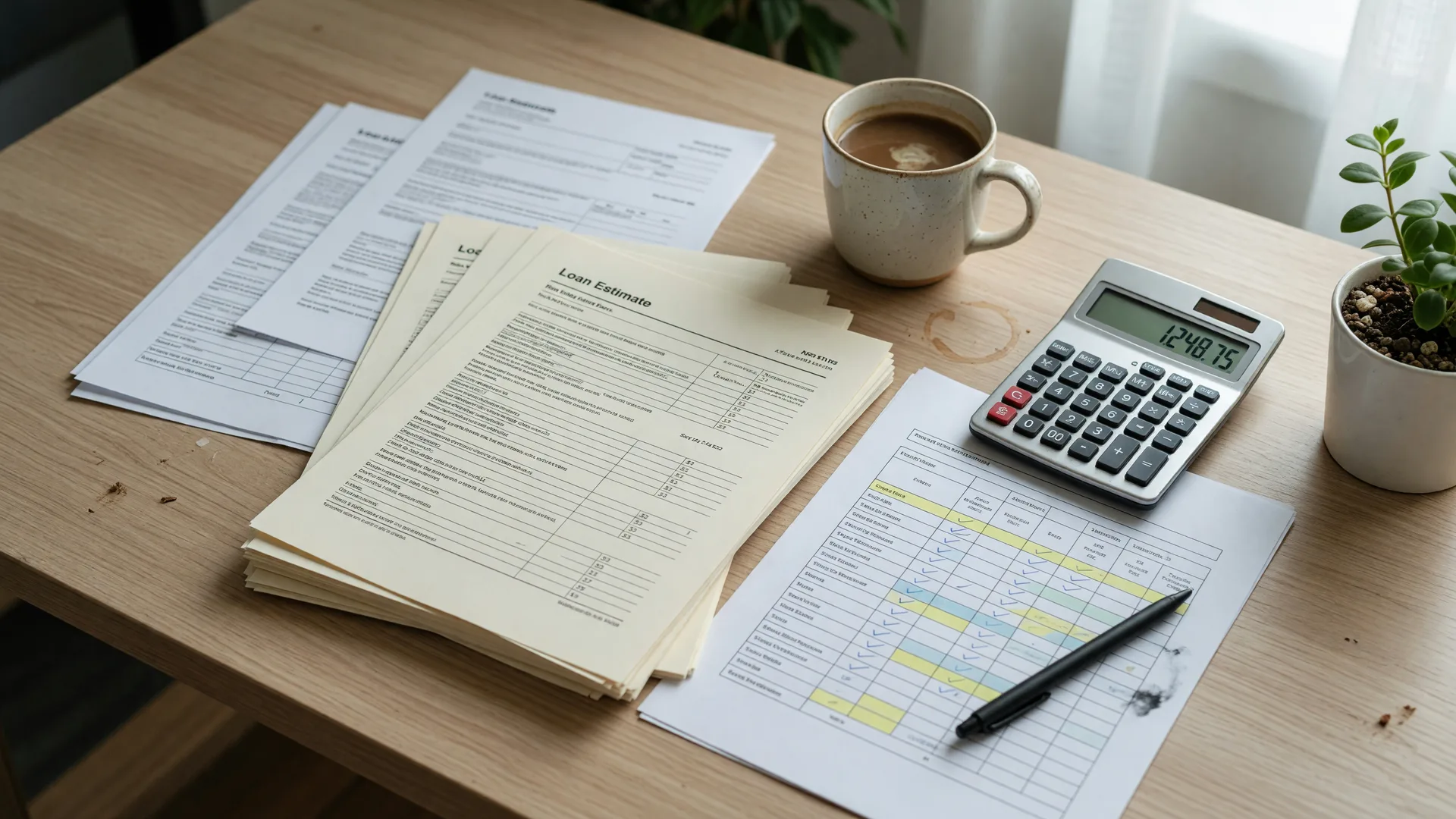
The Loan Estimate is a standardized three-page form that every lender must give you within three business days of receiving a complete application. Because the form is the same everywhere, it is the fair way to compare one lender against another.
To compare fairly, request estimates from at least three lenders for the same loan amount, loan type, and term, and get them on the same day so you are comparing rates from the same market. Then focus on these parts of the form:
- The interest rate and monthly payment on page one, which you can compare directly across lenders.
- Section A, origination charges, which are the fees the lender itself controls, such as points and processing costs, and where competition shows up most clearly.
- The services you can shop for versus services you cannot, so you know which fees are fixed and which you can reduce by choosing your own providers.
- The closing costs and cash to close, which tell you how much money you need on the day of closing.
- The Comparisons section on page three, which shows the APR, the total interest percentage, and the total cost of the loan over time.
The Consumer Financial Protection Bureau explains how to compare Loan Estimates in plain language, and their tool is worth bookmarking. Before you get to the comparison stage, make sure you understand the full buying process by reviewing my Palm Beach County buying guide.
Once you have two or three estimates in hand, you have leverage. Lenders will often match or beat a competitor's offer, especially on origination charges and points, and it costs nothing to ask. Keep the quotes organized, share them selectively, and let lenders compete for your business within a defined window. Just remember to keep the loan details identical across every conversation so the comparison stays apples to apples.
What Is the Difference Between the Interest Rate and the APR?
The interest rate is simply the percentage you pay each year to borrow the money. The annual percentage rate, or APR, is a broader number that includes the interest rate plus certain upfront costs such as points, origination fees, and some closing costs, spread over the life of the loan. That is why the APR is almost always higher than the interest rate.
The APR is useful for comparing the true cost of two loans with similar terms, because it bundles the rate and the fees into one number. Just be careful to compare APRs on the same loan type and term, an APR on a 30-year fixed loan is not comparable to an APR on a 15-year loan or an adjustable-rate mortgage. The CFPB has a clear explanation of the difference between an interest rate and an APR if you want the details.
What Is a Rate Lock, and When Should You Lock?
A rate lock is a lender's guarantee that your interest rate will not change between your offer and closing, as long as you close within the agreed window and nothing changes on your application. Locks are typically offered for 30, 45, or 60 days, and some lenders offer longer windows for an additional fee.
The timing matters. Lock too early and you may pay for a longer window than you need. Lock too late and rates could rise while you are still in underwriting. The general approach is to lock once you are comfortable with the rate and confident you can close within the window, and to ask your lender what happens if a delay pushes you past the lock date. Some lenders also offer a float-down option, which lets you take a lower rate if the market improves before closing, sometimes for a fee, so it is worth asking about before you lock. The CFPB explains what a rate lock is in simple terms.
What Questions Should You Ask Before Choosing a Lender?
Once the numbers look similar, the decision often comes down to process and service. Here are the questions worth asking every lender before you commit:
Your Lender Comparison Checklist
- What documents will I need? A lender who can tell you exactly what to gather makes pre-approval painless.
- What is your typical timeline? Ask how long the appraisal and underwriting usually take and how they handle delays.
- Who will I work with? Confirm you will have a dedicated loan officer or processor you can actually reach.
- Are there any discounts? Ask about first-time buyer programs, military or VA options, and relationship discounts.
- What happens if rates change before closing? Understand the rate lock terms and any float-down options.
- Will my loan be sold after closing? Find out whether your loan will be serviced locally or transferred, and by whom.
Where you buy matters as much as how you finance it. If you are comparing neighborhoods across the county, start with a community that fits your budget, such as West Palm Beach, and pair the home search with the financing plan you build here. For the complete picture, my first-time home buyer guide walks through the whole purchase, and I would be glad to help you connect the pieces. Reach out any time.
Ready to Buy a Home in Palm Beach County?
Choosing the right lender is one of the first steps to a smooth purchase, and I work with buyers through pre-approval, offers, and closing every week. I can help you understand what lenders are asking for and connect you with the process from offer to keys. Call me at (561) 236-9772 or reach out through the contact page.
Rhonda Townsend, REALTOR® · A.I. Certified Agent™ · United Realty Group
(561) 236-9772 ·
rtownsendrealestate@gmail.com
Frequently Asked Questions
Sources
Sources referenced in this article:
- • Consumer Financial Protection Bureau — What is the difference between a mortgage interest rate and an APR?
- • Consumer Financial Protection Bureau — How to compare and negotiate your loan offers
- • Consumer Financial Protection Bureau — What is a lock-in or rate lock on a mortgage?
Disclaimer: This article is provided for general educational and real estate information only. It is not legal, tax, financial, insurance, environmental, engineering, or property-inspection advice. Real estate requirements, costs, risks, policies, and market conditions vary by property and may change. Consult qualified professionals regarding your individual circumstances.